
Why Your Body Reacts Before You Know What's Wrong
October 10, 2026 · 4 min read
The front door closes and your shoulders are already up around your ears.
Nobody said anything. Nothing happened. You weren't thinking about the door. But something in the sound of it — the weight, the speed, the particular way it caught the frame — arrived somewhere fast, and your body answered before you had a chance to weigh in.
Then the rest of you catches up. It's your roommate with groceries. The shoulders come down. Twenty seconds start to finish, and you'd struggle to explain any of it to someone who asked.
This happens more than you notice. A notification tone. A certain silence on the other end of a call. Footsteps on a stair, taken two at a time. The body moves first and the explanation shows up late, if it shows up at all.
There's a reason for that order, and it's structural.
Incoming information doesn't take one route. A rough, fast version of the signal reaches the brain's threat-detection machinery quickly, while the detailed version takes a longer path through the cortex and arrives with the particulars: what the sound actually was, who's at the door, whether anything is wrong at all. Joseph LeDoux mapped these two routes in his fear-conditioning research, and the speed difference is the entire point. A system that waits for certainty is a system that's late.
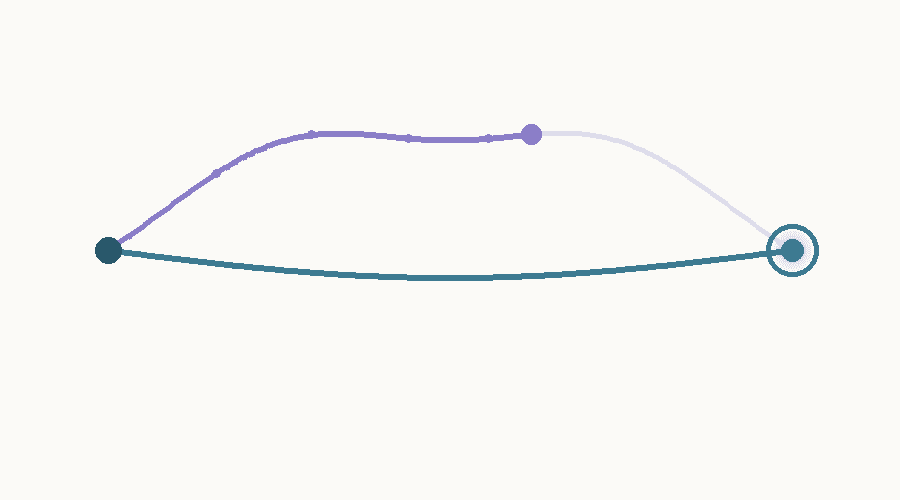
Most of what you've read about this stops there, and that's where it goes wrong — in a way LeDoux himself has spent years pushing back on. The popular version has your amygdala feeling fear while your rational brain lags behind, two selves fighting for the wheel, one primitive and one civilized. He's argued against that framing hard enough to propose renaming the field's central experiment: threat conditioning, not fear conditioning. The machinery that detects a threat and the part of you that feels afraid are doing different jobs, in different places, and the fast one isn't the one producing the feeling.
Which matters, standing in your hallway with your shoulders up.
What ran was detection, working the way detection works: fast, cheap, and wrong a fair amount of the time. The wrongness is the feature. A smoke detector that only sounded when it was certain would be a useless smoke detector, and a threat system that waited for confirmation would have gotten your ancestors killed. Your shoulders went up because something matched a pattern, not because any part of you concluded anything.
So the thing you've been calling an overreaction was a system doing exactly what it's built to do, on information that turned out to be wrong. Those are different problems, and only one of them is about you.
You can't make the fast path slower. That's not available, and anyone selling it is selling something else. What's available is finding out what it's matching on — because it's matching on something, and the something is usually specific. A tone. A time of day. A particular person's particular footsteps. The machinery can't tell you what it's responding to; it doesn't work in language. But it leaves evidence every time it fires, and the evidence is in your body, and it's legible if you write it down while it's still happening.
Five or six times, and the entries start pointing at the same thing.
Next time the door goes, you might catch your shoulders on the way up instead of noticing them on the way down. Nothing else changes. The groceries are still groceries, your roommate still says hey, the whole thing still takes twenty seconds. But you were there for it this time, which is the only part that was ever going to be yours.